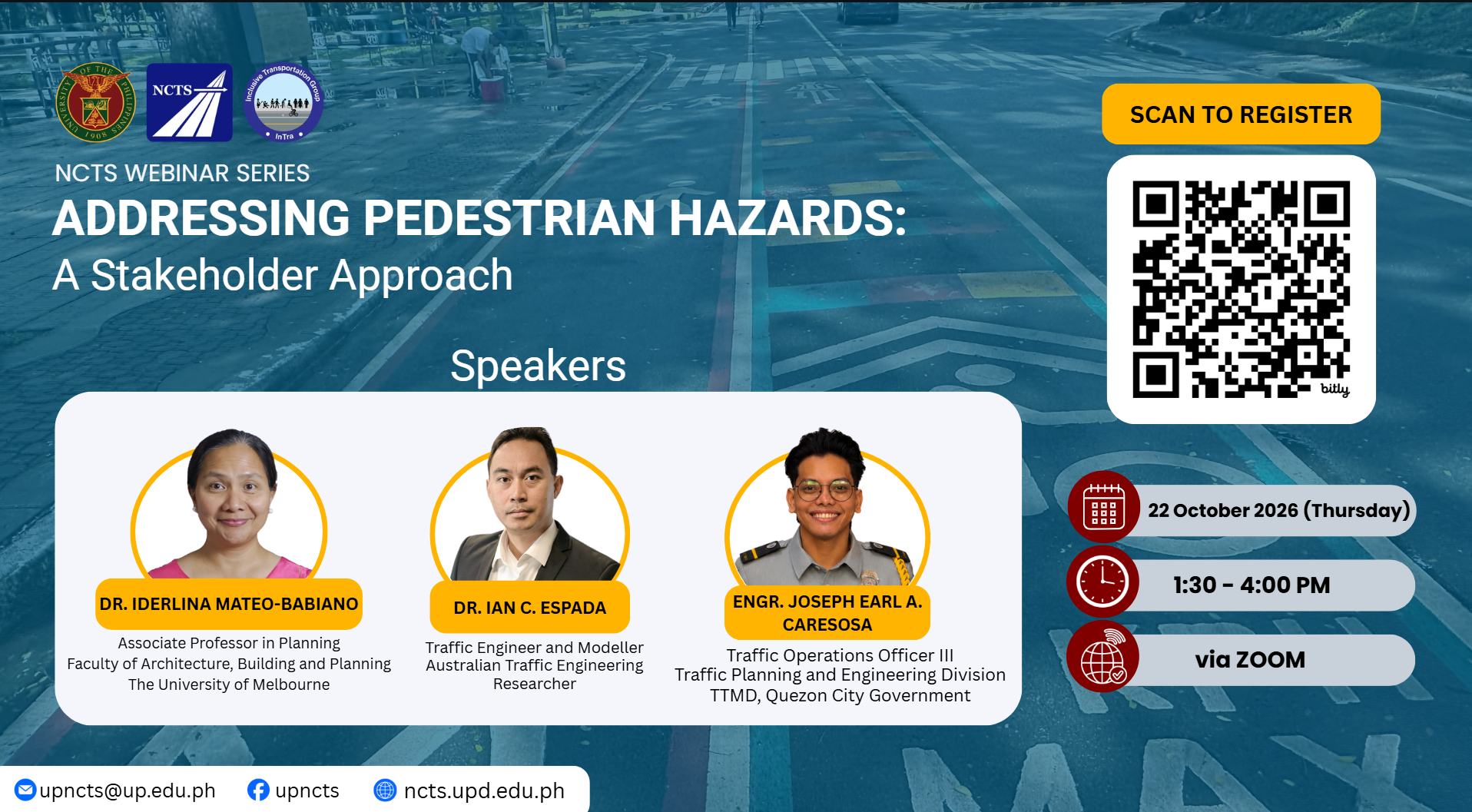
The National Center for Transportation Studies (NCTS) conducted a webinar on Pedestrian Hazards through its Inclusive Transportation (InTra) Group last 22 October 2026. The event brought together participants from academia, government, industry, and the public.
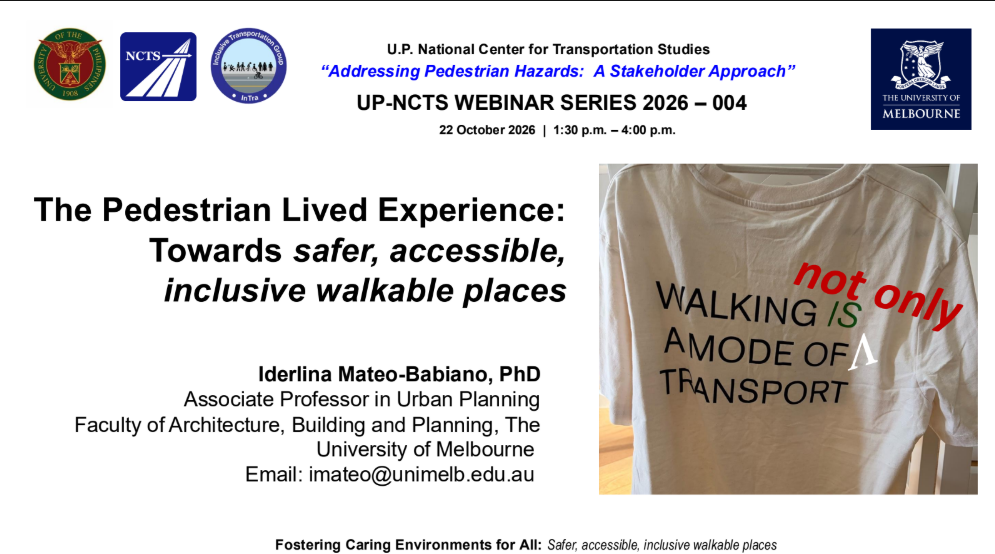
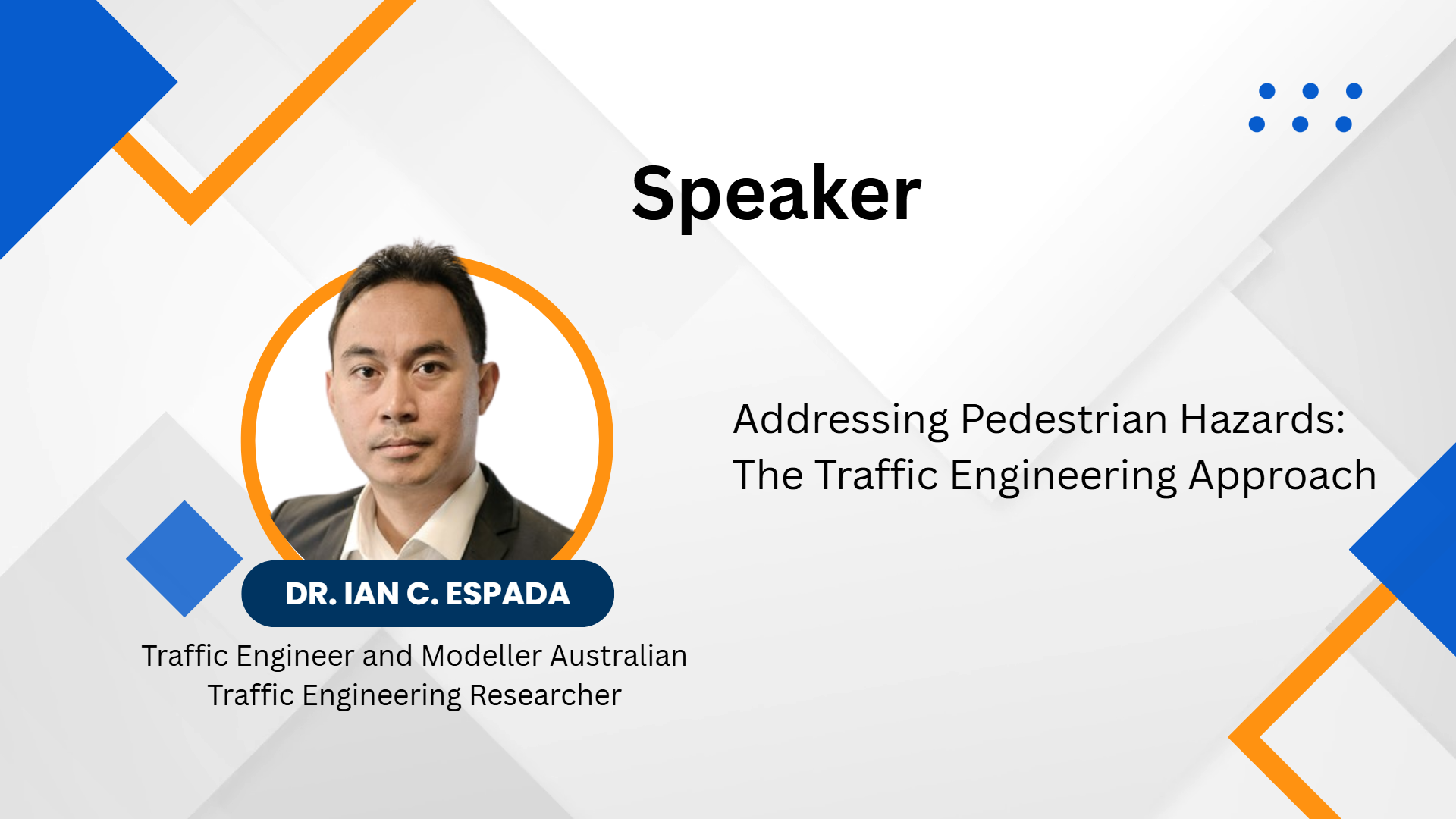
The first speaker was Dr. Iderlina Babiano-Mateo of the University of Melbourne, Australia, who emphasized that it is important to understand the lived experiences of pedestrians and recognize the diverse needs of people of all ages and activities and ensure that our streets are safe, accessible and inclusive. This was followed by Dr. Ian Espada of Australian Traffic Engineering who reminded us that addressing pedestrian hazards requires more than engineering solutions on pedestrian-friendly infrastructures. Meanwhile, Engr. Joseph Caresosa, of Quezon City Government, shared Quezon City’s experiences and best practices and demonstrated that progress is possible when planning, engineering and local governments as well as national governance work together.
After the presentations, an open forum was convened, providing an opportunity for participants to actively interact with the resource speakers.
The webinar ended with the synthesis and the closing remarks given by Dr. Marie Danielle Guillen, Head of the Inclusive Transportation (InTra) Group. She shared that pedestrian safety is a shared responsibility and it calls for stronger collaboration among government agencies, planners, engineers, communities and other stakeholders. She highlighted the importance of ensuring to put people, not vehicles at the center of our streets and mobility systems. The need to strengthen collaboration amongst stakeholders was emphasized since no single agency or sector can solve pedestrian safety challenges alone. The need for shared responsibility, sustained political commitment and a genuine community participation was emphasized. She noted the measure of success should not simply be the number of sidewalks built or pedestrian facilities installed. It should be whether a child could walk safely to school, an older person can cross the street with confidence, a person with disability can move independently, and every pedestrian can reach their destination without fear. It is important to commit to making pedestrian safety a non-negotiable priority, not an after-thought in transportation planning but a fundamental right embedded in the way we design, manage and experience our streets. The need to carry these lessons from the webinar beyond this virtual gathering and translate them into concrete actions towards safer, more walkable and more inclusive greener communities was emphasized.
The Center extends its sincere appreciation to the 188 participants and to all the speakers whose insights made the webinar a meaningful and engaging exchange of ideas.
The InTra Group is very grateful to the resource speakers and moderator, to the other groups of NCTS: Training, Traffic Engineering and Management (TEM) Group, and Transportation Environment, and Energy (TE&E) Group; as well as to the UP Diliman Computer Center for the use of the University Zoom account, for the support provided for the conduct of this webinar.